วันพฤหัสบดีที่ 30 พฤษภาคม พ.ศ. 2556

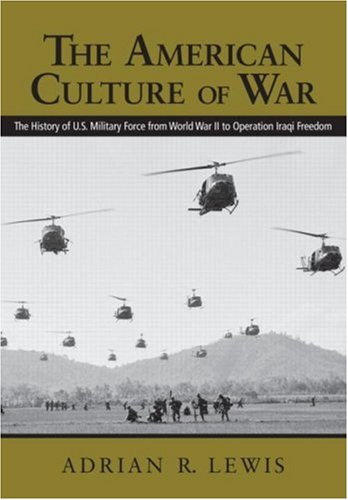
The American Culture of War: A History of US Military Force from World War II to Operation Enduring Freedom

The American Culture of War: A History of US Military Force from World War II to Operation Enduring Freedom Review



Buy From Amazon.com


The American Culture of War presents a sweeping critical examination of every major American war since 1941: the Second World War, Korea, Vietnam, and the First and Second Persian Gulf Wars. As he carefully considers the cultural forces that surrounded each military engagement, Adrian Lewis offers an original and provocative look at the motives people and governments used to wage war, the discord among military personnel, the flawed political policies that guided military strategy, and the civilian perceptions that characterized each conflict. With each chapter similarly structured to allow the reader to draw parallels between the wars, Lewis deftly traces the evolution of US military strategy since the Second World War. Timely, incisive, and comprehensive, The American Culture of War is a unique and invaluable survey of over sixty years of American military history.

For additional information and classroom resources please visit The American Culture of War companion website at www.routledge.com/textbooks/9780415979757.


Buy From Amazon.com

ป้ายกำกับ: , , , , , ,

วันพุธที่ 6 มีนาคม พ.ศ. 2556

Safety Culture (Psychological and Behavioural Aspects of Risk)

Safety Culture (Psychological and Behavioural Aspects of Risk) Review


Buy From Amazon.com


Facility safety is an important commercial risk and it has to be managed insists John Taylor in "Safety Culture". Following an accident, the lack of a 'good' safety management system, compounded by a 'poor' safety culture, is a charge often laid on organisations. Accidents can take up to thirty percentage points off annual profits and, often, failure to manage safety has a much larger social cost that can involve fatalities or serious injury to members of the workforce and public. This has been starkly demonstrated in the railway industry, the international atomic energy industry, and through events in the oil exploration and refinery industry. In business terms, the ultimate cost can be receivership. "Safety Culture" highlights examples ranging from the loss of the Titanic, to Bhopal, and the Tokaimura criticality event. In it Dr. Taylor argues that to minimise risks, any hazardous facility requires robustly engineered safety systems, an effective management system and a developed organisational safety culture. Safety culture is a complex social/scientific concept and Dr. Taylor demystifies it with reference to theory normally associated with mainstream business development and change processes. Sections of the book deal with using safety culture theory as a predictive model, the assessment of safety culture, and how to influence culture change to produce the desired behaviours. This is a practically focused book from an author with vast experience at the top level of high hazard industries, he brings together current academic thinking on the concept of safety culture and provides authoritative practical guidance for operational executives, managers and for students in science, safety technology and engineering disciplines.


Buy From Amazon.com

ป้ายกำกับ: , ,